

PM-DAKSH Yojana 2026
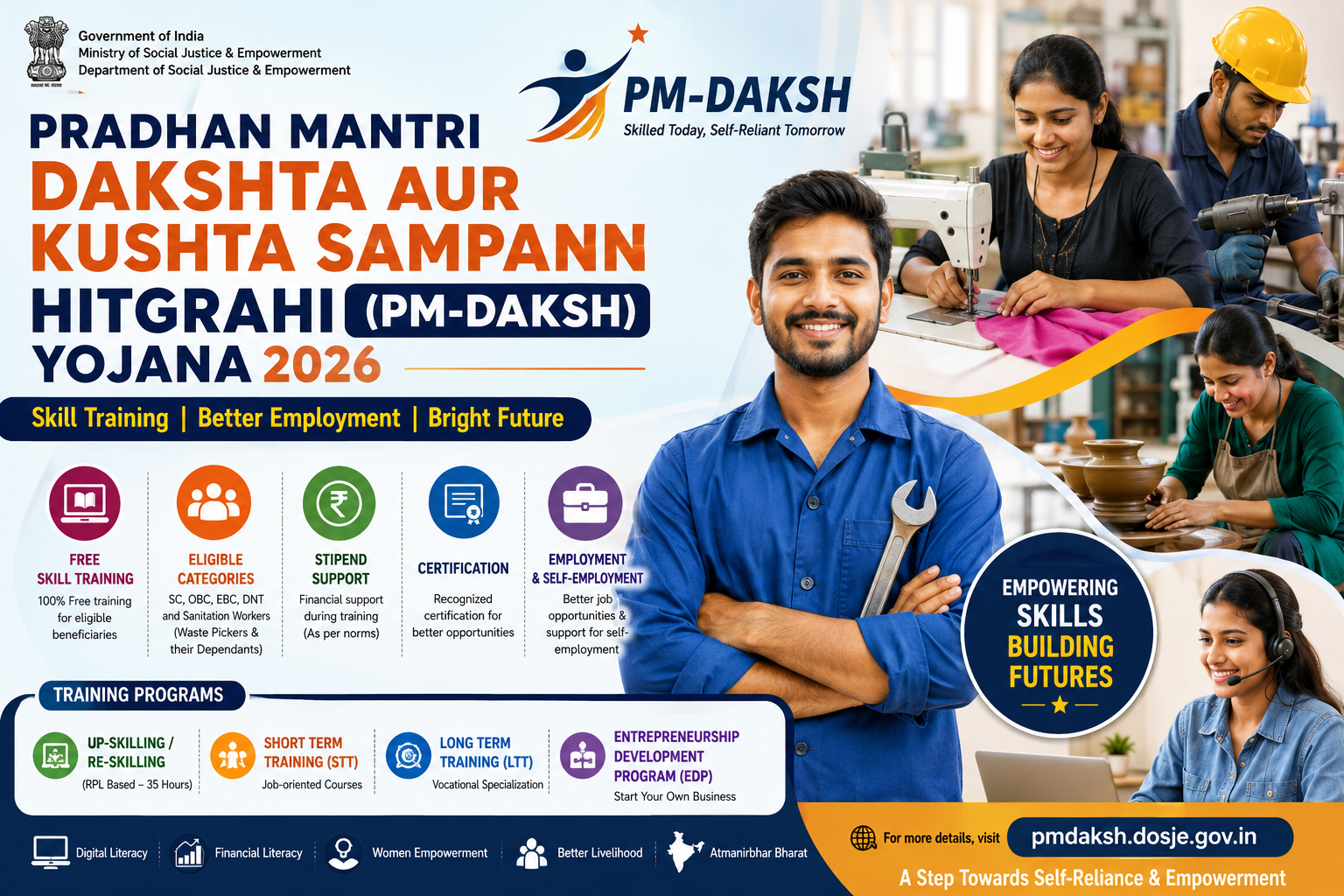
The Pradhan Mantri Dakshta Aur Kushalta Sampann Hitgrahi (PM-DAKSH) Yojana is a Central Sector Scheme of the Government of India designed to improve the skills, employability and income-earning capacity of disadvantaged sections of society.
The scheme was launched during 2020-21 by the Ministry of Social Justice and Empowerment. It focuses on providing quality skill training through suitable institutions so that beneficiaries can obtain wage employment or start self-employment ventures.
PM-DAKSH covers eligible people belonging to Scheduled Castes (SCs), Other Backward Classes (OBCs), Economically Backward Classes (EBCs), De-notified, Nomadic and Semi-Nomadic Tribes (DNTs), and sanitation workers including waste pickers and their dependants, subject to the applicable eligibility conditions.
One of the biggest advantages of the scheme is that training is provided free of cost to eligible beneficiaries, with Government support covering the training cost according to applicable norms.
What is PM-DAKSH?
PM-DAKSH stands for:
Pradhan Mantri Dakshta Aur Kushalta Sampann Hitgrahi
It is a skill-development initiative aimed at increasing the competency of target groups and helping them become employable in both the wage-employment and self-employment sectors.
The scheme is particularly focused on:
- Improving existing skills
- Providing new job-oriented skills
- Increasing earning capacity
- Encouraging entrepreneurship
- Supporting women in self-employment
- Providing youth with employable vocational skills
- Improving the skills of sanitation workers and waste pickers
The broader purpose is economic empowerment through skill development.
PM-DAKSH Yojana Full Form
The full form of PM-DAKSH is:
P – Pradhan Mantri
DAKSHTA – Dakshta
K – Kushalta
S – Sampann
H – Hitgrahi
In full:
Pradhan Mantri Dakshta Aur Kushalta Sampann Hitgrahi Yojana
It is commonly referred to as PM-DAKSH Yojana.
When Was PM-DAKSH Yojana Launched?
PM-DAKSH was launched during 2020-21 by the Ministry of Social Justice and Empowerment, Government of India.
The scheme was introduced to address the need for high-quality skill development among socially, educationally and economically disadvantaged sections of society.
Main Objective of PM-DAKSH Yojana
The main objective is to improve the skill levels of eligible beneficiaries and connect them with opportunities for wage employment or self-employment.
The scheme seeks to:
- Improve technical and vocational skills.
- Increase income-earning opportunities.
- Provide job-oriented training.
- Promote entrepreneurship.
- Help beneficiaries become economically independent.
- Improve the earning capacity of artisans.
- Support women interested in self-employment.
- Provide youth with specialized skills.
- Improve the occupational skills of sanitation workers.
- Promote socio-economic development of disadvantaged communities.
Who Can Benefit From PM-DAKSH?
PM-DAKSH primarily covers the following target groups:
1. Scheduled Castes (SC)
Eligible individuals belonging to Scheduled Castes can apply, subject to the scheme’s conditions.
Income limit: No income criterion is specified for SC beneficiaries.
2. Other Backward Classes (OBC)
OBC candidates can benefit if their annual family income is below the prescribed limit.
Income limit: Annual family income should be below ₹3 lakh.
3. Economically Backward Classes (EBC)
The scheme also covers eligible EBC beneficiaries according to the applicable guidelines.
4. De-notified, Nomadic and Semi-Nomadic Tribes (DNT)
Eligible persons belonging to DNT communities are covered.
Income limit: No income criterion is specified for DNT beneficiaries under the official scheme information.
5. Sanitation Workers and Waste Pickers
Sanitation workers, including waste pickers, and their dependants are also covered.
Income limit: No income criterion is specified for sanitation workers under the official eligibility information.
PM-DAKSH Age Limit
The general age criterion for PM-DAKSH skill-development training is:
Minimum Age: 18 years
Maximum Age: 45 years
Therefore, candidates between 18 and 45 years can apply, subject to the category-specific requirements and the particular training programme.
PM-DAKSH Eligibility Criteria
The basic eligibility requirements include:
| Category | Eligibility |
|---|---|
| Scheduled Caste | SC certificate; no income limit |
| OBC | OBC certificate + annual family income below ₹3 lakh |
| EBC | As per applicable scheme conditions |
| DNT | Eligible DNT category; no income limit specified |
| Sanitation Workers/Waste Pickers | Eligible occupational category; no income limit specified |
| Age | Generally 18–45 years |
The exact documentation and eligibility requirements can vary according to the category and training programme, so applicants should check the official portal before applying.
PM-DAKSH Training Programs
PM-DAKSH provides different types of skill-development programmes.
The major categories include:
- Up-skilling / Re-skilling
- Short-Term Training (STT)
- Long-Term Training (LTT)
- Entrepreneurship Development Programme (EDP)
The official FAQ and scheme guidelines describe these programmes as being designed for different needs, from upgrading existing occupational skills to preparing beneficiaries for employment and entrepreneurship.
1. Up-Skilling and Re-Skilling
This component is designed mainly to improve the existing skills of eligible sanitation workers, including waste pickers, through Recognition of Prior Learning (RPL).
The training focuses on:
- Safe sanitation practices
- Healthy occupational practices
- Improved work processes
- Better skills
- Standardized certification
The official scheme information states that the training is approximately 35 hours, keeping the occupational schedule of trainees in mind.
For eligible Safai Mitras and waste pickers, a stipend of ₹500 per person is provided during this training as compensation for wage loss.
2. Short-Term Training (STT)
Short-Term Training is intended for eligible members of SC, OBC, EBC and DNT communities and sanitation workers/waste pickers who want to acquire skills for employment or self-employment.
Examples of job-oriented areas mentioned by the official scheme include:
- Tailoring
- Furniture making
- Food processing
- Carpet weaving
- Beautician work
- Leather work
- Latex harvesting
- Tyre fitting
- Digital literacy
- Financial literacy
Training follows relevant National Skill Qualification Framework (NSQF), National Occupational Standards (NOS) and Qualification Pack requirements where applicable.
The official information describes STT programmes as generally being less than 1,200 hours, depending on the job role.
3. Long-Term Training (LTT)
Long-term training is intended to provide more extensive vocational specialization.
According to the official PM-DAKSH FAQ, long-term courses can be aimed at youth, women and artisans belonging to eligible SC, OBC, EBC and DNT categories who meet the educational requirements for the particular course. The FAQ describes examples of long-term training durations of around 650 hours or seven months, depending on the programme.
The exact course, qualification and duration depend on the training programme available through approved institutions.
4. Entrepreneurship Development Programme (EDP)
The Entrepreneurship Development Programme is designed for eligible beneficiaries who want to establish their own business or self-employment activity.
The programme focuses on areas such as:
- Entrepreneurship skills
- Business planning
- Financial literacy
- Business management
- Self-employment opportunities
- Understanding markets
- Managing a small enterprise
The Department may work with organizations such as NIESBUD or other appropriate institutions for conducting EDP training.
Is PM-DAKSH Training Free?
Yes.
The training provided under PM-DAKSH is free of cost for eligible beneficiaries. The Government provides support for the training cost according to the applicable norms.
This is one of the most important features of the scheme because the financial burden of skill training can otherwise prevent disadvantaged candidates from gaining vocational qualifications.
PM-DAKSH Stipend
Eligible trainees can receive financial support depending on the type of training and beneficiary category.
For non-residential short-term training, the official PM-DAKSH information currently lists:
- SC candidates: ₹1,500 per month
- OBC/EBC/DNT candidates: ₹1,000 per month
- Sanitation workers including waste pickers and their dependants: ₹1,500 per month
The stipend generally requires 80% attendance.
For residential programmes, boarding and lodging expenses are generally covered within applicable training-cost norms rather than providing the same separate stipend; the official information provides a separate ₹500/month provision for eligible Safai Mitras, waste pickers and their dependants in specified cases.
Because stipend rules can depend on the training category and current guidelines, applicants should verify the specific course terms before enrollment.
PM-DAKSH Training Duration
Training duration depends on the type of programme.
| Training Type | Approximate Duration |
|---|---|
| Up-skilling / Re-skilling | Around 35 hours |
| Short-Term Training | Depends on job role; generally under 1,200 hours |
| EDP | Course-specific |
| Long-Term Training | Course-specific; official FAQ cites programmes around 650 hours/7 months |
The exact duration is determined by the selected job role and applicable scheme guidelines.
What Documents Are Required?
The documents required depend on the applicant’s category.
SC Candidates
Generally:
- SC caste certificate
- Identity proof
- Other documents requested during registration
OBC Candidates
Generally:
- OBC certificate
- Income certificate showing annual family income below ₹3 lakh
- Identity proof
- Other required documents
Sanitation Workers/Waste Pickers
An appropriate occupational certificate/document may be required.
The official PM-DAKSH FAQ specifies that occupational certification can be issued by designated authorities such as appropriate local government, municipal, government departmental and other authorized officials.
Important: Applicants should check the official portal for the latest document requirements before submitting an application.
How to Apply for PM-DAKSH Yojana?
The application process is generally carried out through the official PM-DAKSH portal.
Step 1: Visit the Official PM-DAKSH Portal
Go to the official PM-DAKSH portal.
Step 2: Check Eligibility
Check your:
- Age
- Category
- Income requirement, where applicable
- Required documents
- Available courses
Step 3: Select a Training Programme
Applicants can review the available training programmes and choose an appropriate course based on eligibility and interest. The official portal provides listings of skill-training programmes and participating institutions.
Step 4: Registration
Complete the candidate registration process when the registration window is open.
Step 5: Submit Required Information
Enter the required personal, category and other information and upload/submit documents as instructed.
Step 6: Training
After selection/enrollment, the candidate attends the assigned training programme.
Step 7: Certification
Successful candidates can receive certification through recognized awarding bodies as applicable to the programme.
How to Find PM-DAKSH Training Centres?
The official PM-DAKSH portal provides information about available training programmes, including:
- Job role
- State
- City
- Training institute
- Address
- Duration
- Registration information
- Minimum qualification
Applicants can use this information to find suitable training opportunities.
Tip: Do not pay an unauthorized person or private agent for a course that is supposed to be free under PM-DAKSH.
Can a Person Take PM-DAKSH Training More Than Once?
According to the official FAQ, a person is eligible to undergo training under the skill-development programme only once. A candidate is also not allowed to participate in more than one PM-DAKSH skill-training programme simultaneously.
Is PM-DAKSH Training Online or Offline?
Training may be provided through online as well as offline modes, depending on the programme and applicable arrangements.
Candidates should check the specific course details before enrollment.
What Happens After Training?
PM-DAKSH is not limited to classroom training.
After successful completion, training institutions are expected to assist or facilitate beneficiaries toward:
- Wage employment
- Self-employment
- Entrepreneurship
- Further economic opportunities
The official FAQ also states that beneficiaries completing self-employment-oriented training/EDP may be able to seek concessional financial assistance from relevant corporations, subject to their eligibility and applicable rules.
PM-DAKSH and Self-Employment
One important feature of PM-DAKSH is its focus on self-employment.
A person who acquires a useful skill can potentially use that skill to start a small business.
For example:
- A tailoring trainee can start a tailoring unit.
- A food-processing trainee can start a small food business.
- A furniture-making trainee can work independently.
- A beautician trainee can establish a beauty service.
- A skilled artisan can improve the quality and value of existing products.
The scheme’s broader objective is therefore not only to provide certificates but to improve income-generation capacity.
PM-DAKSH for Women
Women are an important target group under the scheme.
PM-DAKSH encourages women to acquire skills that can help them enter self-employment while balancing domestic responsibilities.
Skills such as tailoring, food processing, handicrafts, beauty services and other home-based or flexible occupations can potentially provide additional income opportunities, depending on local market demand.
PM-DAKSH for Youth
For young people, the scheme focuses on vocational skills that can improve their position in the job market.
Youth can benefit from:
- Job-oriented skills
- Vocational specialization
- Entrepreneurship training
- Digital literacy
- Financial literacy
- Employment support
This can help bridge the gap between formal education and practical workplace skills.
PM-DAKSH for Artisans
Artisans can use up-skilling and re-skilling opportunities to improve their traditional occupations.
Better skills can potentially help artisans:
- Improve product quality
- Increase productivity
- Adopt improved designs
- Improve earning capacity
- Reach wider markets
The scheme specifically recognizes the importance of improving the revenue-generation capacity of artisans in their existing occupations.
PM-DAKSH for Sanitation Workers
Sanitation workers and waste pickers are specifically included among the target groups.
The programme aims to improve their occupational skills, particularly through up-skilling and re-skilling under Recognition of Prior Learning.
Training can cover:
- Safe sanitation practices
- Occupational health and safety
- Better processes
- Skill certification
- Improved work practices
This component is especially significant because it seeks to improve both skills and working conditions for an important section of the workforce.
PM-DAKSH: Important Benefits
The major benefits of PM-DAKSH include:
Free Training
Eligible beneficiaries do not have to pay training fees.
Skill Development
Candidates can acquire new skills or improve existing skills.
Employment Opportunities
Training is designed to improve access to wage employment.
Self-Employment
Beneficiaries can develop skills for starting their own businesses.
Stipend Support
Eligible trainees can receive stipend support under applicable programmes and attendance conditions.
Certification
Successful trainees can receive recognized certification where applicable.
Entrepreneurship
EDP training encourages beneficiaries to become entrepreneurs.
Digital and Financial Literacy
Some job-oriented programmes incorporate digital and financial literacy components.
PM-DAKSH: Key Points at a Glance
| Particular | Details |
|---|---|
| Scheme Name | PM-DAKSH Yojana |
| Full Name | Pradhan Mantri Dakshta Aur Kushalta Sampann Hitgrahi |
| Ministry | Ministry of Social Justice & Empowerment |
| Type | Central Sector Scheme |
| Launched | 2020-21 |
| Main Objective | Skill development and economic empowerment |
| Age | 18–45 years |
| Main Target Groups | SC, OBC, EBC, DNT, sanitation workers/waste pickers |
| Training Fee | Free for eligible beneficiaries |
| Training Types | Up-skilling/Re-skilling, STT, LTT, EDP |
| Employment | Wage employment & self-employment |
| Application | Official PM-DAKSH portal |
PM-DAKSH vs Other Skill Development Schemes
PM-DAKSH has a specific social-justice focus.
While many skill-development programmes are designed for the general population, PM-DAKSH specifically targets disadvantaged communities and occupational groups covered under the scheme.
Its focus is therefore not merely on skill acquisition but also on social inclusion, economic empowerment and improved livelihood opportunities.
Important Things Applicants Should Remember
Before applying, candidates should keep the following points in mind:
- Check whether you belong to an eligible category.
- Verify the age requirement.
- Check the applicable income criterion.
- Keep caste/category documents ready.
- Keep income documents ready where required.
- Choose a course according to your qualification and interest.
- Check the training centre carefully.
- Maintain the required attendance.
- Do not pay unauthorized agents for free training.
- Check the official portal for the latest registration dates and available courses.
Frequently Asked Questions (FAQs)
What is PM-DAKSH Yojana?
PM-DAKSH is a Central Sector skill-development scheme launched by the Ministry of Social Justice and Empowerment to improve the skills and employment/self-employment opportunities of eligible disadvantaged groups.
When was PM-DAKSH launched?
PM-DAKSH was launched during 2020-21.
Who can apply for PM-DAKSH?
Eligible people belonging to SC, OBC, EBC, DNT and sanitation-worker/waste-picker categories can apply according to the applicable conditions.
What is the age limit?
The general age criterion is 18 to 45 years.
Is PM-DAKSH training free?
Yes. Training is provided free of cost to eligible beneficiaries.
Is there any stipend?
Yes. Stipend support is available for eligible beneficiaries under specified training programmes, subject to the applicable conditions such as attendance.
What is the income limit for OBC candidates?
The official scheme information specifies annual family income below ₹3 lakh for eligible OBC candidates.
Is there an income limit for SC candidates?
No income criterion is specified for SC beneficiaries under the official PM-DAKSH eligibility information.
Can I take PM-DAKSH training twice?
According to the official FAQ, a person can undergo the skill-development training programme only once.
Can I take two PM-DAKSH courses at the same time?
No. A candidate is not allowed to participate in more than one skill-development programme simultaneously.
Where can I register?
Applicants should use the official PM-DAKSH portal and check whether registration is currently open.
Does PM-DAKSH provide jobs directly?
The scheme is primarily a skill-development programme. Training institutions facilitate or assist eligible trainees toward wage or self-employment after successful completion; employment outcomes depend on the programme, market and individual circumstances.
Conclusion
The Pradhan Mantri Dakshta Aur Kushalta Sampann Hitgrahi (PM-DAKSH) Yojana is an important Government of India initiative for skill development and economic empowerment of disadvantaged communities.
Through free skill training, up-skilling, re-skilling, short-term courses, long-term vocational training and entrepreneurship development, the scheme aims to help eligible beneficiaries improve their employment prospects and earning potential.
The scheme is particularly valuable because it combines skill development with employment and self-employment opportunities. It also provides specific support to sanitation workers, waste pickers, artisans, women and youth.
If you are between 18 and 45 years old and belong to an eligible category, you should check the current courses and registration status on the official PM-DAKSH portal before applying.
Official Links
